top of page

Notes: Art History Images Chapter 3

  • Writer: dbyounger616
    dbyounger616
  • Sep 22, 2019
  • 1 min read

A golden Egyptian mask depicting a styalized visual of King Tut's face.
Funerary Mask of Tutankhamun, 1323 BCE, rediscovered 1922, King Tut was the deformed son of the Heritic King Akhenaten. It is believed that he was installed as a puppet ruler by his uncle Ay who may have had him killed when he reached maturity and started to rebel. He was a rather forgetable leader and his tomb was eventually covered over with debry and small huts at the base of the tomb of Rameses VI. Dispite being robbed twice, the robbers were unable to take anything of value before the tomb was completely forgotten about leading to one of the greatest archeological finds of all time.

A siltstone board depicting King Narmer wearing crowns from North and South Egypt.
The Palette of Narmer, 3200 BCE, discovered 1897, depicts the union of North and South Egypt under King Narmer who is wearing headresses from both on opposite sides of the palette. Used to hold eye makeup at ceremonies.

Three large pyramids behind three smaller ones.
The Great Pyramids, Khufu 2551 BCE was the tallest man made structure in the world for 3800 years. Khafre 2520 the most intact. Menkaure 2490 BCE

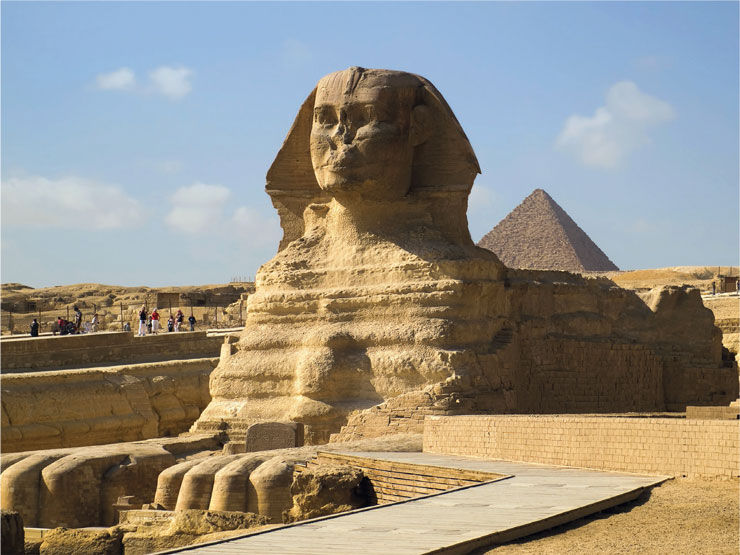
The Great Sphinx of Giza, "The Father of Dread" at the Funerary Complex of Khafre.
The Great Sphinx, Funerary Complex of Khafre, "The Father of Dread" 2558 BCE, first modern archeological dig at site in 1817 AD. Statue shoes traces of red, yellow, and blue paint and a beard was at one point attached to the Sphinx but it was thought to have been a later addittion.

A slate statue of King Menkaure and one of his wives, Rekhetre or Khameremebtry.
Menkaure and a Queen, 2548 BCE, discovered in 1910 in a tunnel dug by theives underneath the Valley Temple of the tomb of Menkaure by students from Harvard University and the Boston Museum of Fine Arts.

A man sitting criss cross applesauce wearing a kilt holding an invisible pen.
Seated Scribe, 2600 BCE, discovered 1850 North of the Serapheum's line of Spinxes. His identitiy is unknown but it is theorized that he may have been a scribe to an official named Pehemefer.

Ti watching his men hunt hippopotomus.
Ti Watching a Hippopotamus Hunt, 2450 BCE decoration on the wall of the Mastaba of Ti. Uses vertical lines to give the impression of stateliness.

Yellow quartzite statue of the head of Senusret III.  The large ears and nose are broken off along with part of the headress.
Head of Senrusret III, 1836 BCE, sculpted from yellow quartzite, Senruset III was a legendary military leader thought to have been the inspiration behind Sesostris who was said to have lead an expedition into Europe.

A temple carved into the side of a mountain.
Funerary Temple of Hatshepsut, 1488 BC, was built to commemorate the 2nd female Pharaoh and first successful recorded female ruler Hatshepsut. Built from limestone instead of the usual sandstone keeping this temple glorifying Hatshepsut's devotion to the god Amon Ra in fairly good condition.

King Akhenaten Nefertiti and two of their children being blessed by Aten
Akhenaten and his Family, 1353 BCE, the Egyptians considered Akhenaten a complete heretic and successfully tried to forget everything this Pharaoh ever did until 1824 when it was accidently discovered by archeologists investigating burial grounds in the area. Akhenaten tried changing Egypt into a monotheistic society overnight pushing his religious beleif in the sun god Aten on them and moving the capitol. He was the father of King Tut who was used to reverse these decisions and try to erase the ruler from record.

A papyrus picture depicting the journey of Hunefer through the afterlife.
Judgment of Hunefer before Osiris, 1285 BCE. Hunefer is guided into the afterlife by Anubus the jackel headed god of embalming and cemetaries, his heart is weighed against an ostrich feather. The "eater of dead" Ammit (part crocodile, lion, and hippo monster) isn't ordered to eat him by Thot and broght before Osiris the god of the afterlife by Horis the falcon-headed god of the earth.

Stokstad, M., Cothren, M. W. Art History. [VitalSource Bookshelf]. Retrieved from https://bookshelf.vitalsource.com/#/books/978013448505


Comments


©2019 by Outlawed BRO. Proudly created with Wix.com

bottom of page